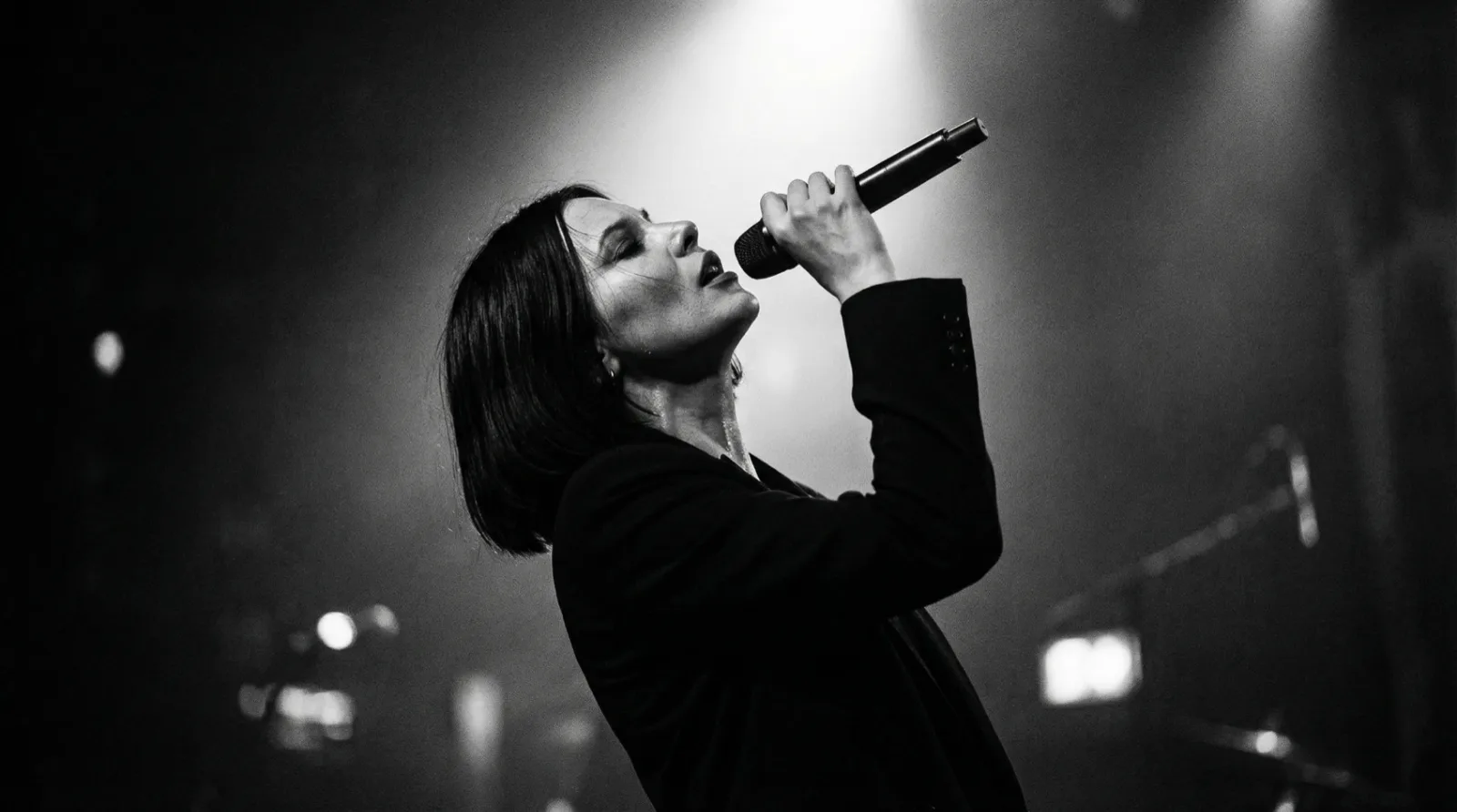
Iris Selis is a synth-pop artist from Sweden with an EP on every streaming service. She has listeners in several countries. She has never existed. This is the story of why I created her, what I learned, and why I chose to stop where I stopped.
Reverse-engineering a hit
You could say I reverse-engineered TikTok. Iris was created as an experiment: a synth-pop queen from Sweden with a four-track EP, “Feral”, out on every digital streaming platform. She has her own website too. It was built in under fifteen minutes.
I have made a lot of music with the help of AI. Or rather, together with AI. I have an old Dropbox folder full of guitar riffs and lyrics that have now come to life. I describe how I want it to sound, upload, download, into Logic, tinker, hum, mark out drums, upload again and tweak until it sounds decent. I am no professional. I talked to Claude constantly for help along the way, and when I needed to dig deeper I used Claude Code for the analysis. Most of what I have made has been hard rock and metal.
This time I wanted to do something different. Create from analysis. An EP with four songs that make people dance. Not old hard rock riffs, but something that gets you going on a Friday or at the gym.
What makes a song stick?
It all started with a simple question: how do you create songs that actually land? That make people feel something, and get played again and again? There have to be patterns. Producers know which chord progressions work. Songwriters know which themes resonate.
So I sat down with Claude and started analysing. Not individual songs, but patterns. What keeps recurring in the music that dominates the charts right now? These are my notes.
Tempo matters more than you think. 95 to 100 BPM for emotional impact: slow enough to be felt, but not so slow that it becomes a ballad. 115 to 130 BPM for dancing and energy.
Structure follows expectations. Verse, pre-chorus, chorus is the standard. But it is the bridge that decides whether a song becomes memorable. The bridge has to change something: new energy, a new perspective, an emotional peak.
Production is about balance. The verses need space, room for the song to breathe. The chorus should be full, layer on layer. But the production must never feel overworked.
The lyrics are where the magic happens. The songs that really stick have something in common: a confessional honesty. They feel personal but universal. The artist takes responsibility instead of being a victim. Humour is used to deal with pain. And there is always a line you can quote, something people can use as a caption or a sound on TikTok.
The psychology behind it
There is a lot of psychology behind why music lands, so I kept digging. What triggers people to react?
Recognition. When you hear a line and think “that's me”, something happens in the brain. You feel seen, understood, less alone. That feeling is addictive.
Relatable situations. Heartbreak. Insecurity. Making a fool of yourself. Getting back up. Setting boundaries with someone who treats you badly. Experiences almost everyone has, but that we rarely talk about out loud.
Belonging. When millions of people sing the same chorus, a community forms. The song becomes a shared language.
Aspiration. The artists we love most are not just relatable. They are versions of ourselves that we want to be. Stronger, braver, more self-aware. They show that you can be vulnerable and strong at the same time.
When I understood that, I realised I wasn't just making music. I was designing an experience. I was using psychological mechanisms to create an emotional bond between a listener and an artist who doesn't exist.
Building a person
With the analysis as a foundation, I started building an artist. Not just songs, but a person. First, who she would be. Strong but vulnerable. Self-aware but not self-absorbed. Someone who messes up sometimes but owns it. And sometimes a little lost, in need of help finding her way.
I wanted her lyrics to give you that feeling of “she gets me”. The recognition that makes you play the song one more time and send it to a friend with the words “this is us”.
Then her voice. Intimate, close to the microphone, conversational. Soft and thoughtful in the verses, more power in the chorus, the emotional shift in the bridge. Each song got a theme tied to life questions that keep coming back on social media: mental health, self-esteem, relationships, setting boundaries, strength after pain. Not to be calculating, but because those themes resonate for a reason.
The responsibility
In the middle of the process, while I sat polishing lines and choosing which emotional triggers to use in which order, it hit me. If this works, if people really connect with Iris and look up to her, then I have a responsibility. Quite a big one.
Because if I can design an artist that people trust and see as a friend, it matters which stories she tells. Which values she stands for. What she normalises and what she questions. Creating was no longer just an experiment in what is possible. It became an ethical question.
So I made a decision. If Iris is going to exist, her stories have to be good ones. Transparent. They should make the listener a better version of themselves, not exploit insecurities for streams. That doesn't mean she is flawless. Some lyrics will be questioned. But that is part of who she is: someone who tries, gets it wrong sometimes, and learns.
It felt almost absurd to sit there writing an ethics policy for an artist who doesn't exist. But the more I thought about it, the more I realised this may be exactly what the future looks like. Those who create, whether it is music, content or AI characters, have to take responsibility for what they release into the world.
The strange feeling in my stomach
I have to be honest. This project has given me a strange feeling in my stomach. I love music and always have. I have many friends who are real musicians, who have spent years developing their craft and make a living from what they create. This is something else.
Anyone can now create music that is “good enough”. Put in a little more time and it can be really good. And that is now. AI is hardly going to get worse. So what happens to those who have dedicated their lives to it? Income, business models, the whole ecosystem that made it possible for artists to live on their art.
I have asked around a hundred people what they think of AI-generated music. About eight out of ten say the same thing: as long as it's good, I don't care how it was made. I get that. I listen to music for how it makes me feel, not for how it was produced.
And yet. Maybe the streaming services should have a separate section for AI music? But how do we know what counts as AI? If I use AI for mastering, is it AI music? If I write the lyrics but AI writes the melody? If AI gives me suggestions that I then change? There are no clear answers. Only more questions.
This is where I stop
I went back and forth between “this is so cool” and “what am I doing” several times during the process. But I did it anyway. Because I am so curious about how far you can take it.
I have already done photo shoots, music videos and a website. I could put her on every social platform too. Build a whole persona with comments and interactions.
But no. This is where I stop. With a growing sense that the technology has outrun our ability to handle the consequences. This needs to be discussed. Properly.